GPT-6.1 Terra is now official. OpenAI has released it in ChatGPT Work and Codex for Plus, Pro, Enterprise and Edu users, and in the API as gpt-6.1-terra. 1
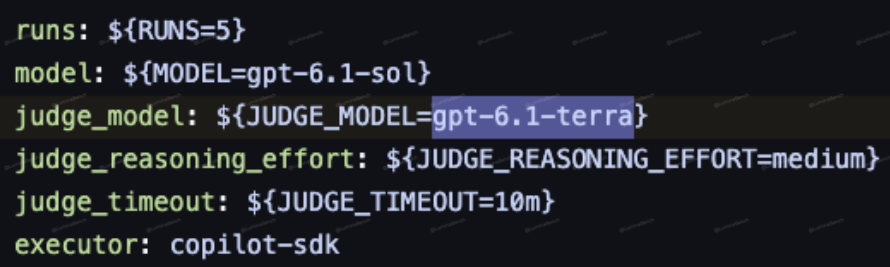
That is the same identifier we found in a Microsoft pull request last week. It appeared as the default judge in 18 EF Core evaluation configs. We had a name and a role then; today we have the model, prices and results to go with it.
The price is the clearest part of the pitch
Standard API rates are $1 per million input tokens, $0.05 for cached input and $5 for output. Each is half the corresponding GPT-6.1 Sol rate. For someone running an agent through a lot of screens, forms or documents, that changes how expensive the routine steps become. 2
| Model | Input | Cached input | Output |
|---|---|---|---|
| GPT-6.1 Terra | $1.00 | $0.05 | $5.00 |
| GPT-6.1 Sol | $2.00 | $0.10 | $10.00 |
Terra’s API documentation lists a 1,050,000-token context window and up to 128,000 output tokens. Reasoning runs from none to max, with medium as the default. Requests above 272,000 input tokens cost twice the input and cache rates and 1.5 times the output rate for the full request, so the headline prices do not apply across that entire context window. 3
A useful step up, with a mixed benchmark picture
Our first reaction to the charts was fairly muted. A sizeable improvement over the old Terra is welcome, but it is not the same thing as moving past today’s strongest models. The more interesting part of this release is what Terra can finish quickly at its lower price. 4
On Terminal-Bench 4.0, OpenAI reports 50.3% at maximum reasoning, up from GPT-5.6 Terra’s published 21.5%. Its chart also puts Claude Sonnet 5.5 at 70.6% at max effort. 1
For computer use, OpenAI reports a 15-point gain over GPT-5.6 Terra on Agents’ Last Exam at medium effort, at roughly a third of the cost. It also reports completing that benchmark over three times faster than Astra and Sol. We have not independently rerun those evaluations. 1
On its internal factuality stress test, OpenAI reports a drop from 53.6% to 16.7% errors at low effort, with 4.3% at max. Those are results on challenging prompts, rather than everyday error rates. 1
What the safety claims actually mean
Our follow-up was more sceptical about the emphasis on safety. OpenAI’s system card classifies Terra as Critical for cybersecurity and High for biological and chemical capability, and says it uses the safeguards stack shared with Sol and Astra. Those labels describe capability risk; the safeguards are intended to control how those capabilities are used. 5 6
Sources & references
- OpenAI: Introducing GPT-6.1 Terra ↗
26 October 2026. Launch availability and company-reported performance. Chart PNGs were downloaded with the page’s own export controls.
- OpenAI API pricing ↗
Checked 26 October 2026. Standard text-token rates for GPT-6.1 Terra and GPT-6.1 Sol; other service tiers and charges are separate.
- OpenAI API: GPT-6.1 Terra model details ↗
Checked 26 October 2026. Context window, output limit, supported reasoning settings and the long-context pricing threshold.
- Lumina: first reaction to Terra’s benchmarks ↗
26 October 2026. Our public reaction to the launch benchmark charts, read through X’s public oEmbed response.
- Lumina: Terra’s benchmark and safety positioning ↗
26 October 2026. Our follow-up reaction, read through X’s public oEmbed response.
- OpenAI: GPT-6.1 Terra system-card addendum ↗
Published 26 October 2026. Preparedness classifications and safety-evaluation scope; company assessments rather than independent certification.