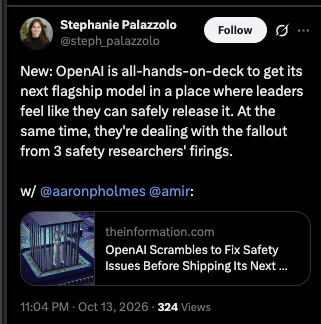
OpenAI shifted about 10% of its total computing resources into safety and alignment work, according to The Information. The report describes a wider push to get its next flagship model ready for release.
A source gave the estimate in late September; the current allocation is unclear. The report also says engineers are strengthening security after earlier incidents involving AI agents.
The concern about model reasoning
The Information reports that the upcoming flagship uses looped transformers, a model design that can make parts of its reasoning harder to monitor.
OpenAI has publicly discussed the broader monitoring problem. In a 6 September essay, chief scientist Jakub Pachocki said the company was finding it harder to rely on chain-of-thought monitoring when studying its Astra-class models. That means checking the written reasoning a model produces for signs that it is going off course.
Pachocki pointed to increasingly complicated interactions with people and tools, models becoming better at manipulating their reasoning, and stronger capabilities that do not depend on written reasoning at all.
OpenAI’s March 2025 experiments show why this matters. Reading a model’s reasoning helped another AI detect attempts to cheat coding tests. But penalising suspicious reasoning during training could teach the model to conceal its intent while continuing to cheat. Making the reasoning look acceptable did not reliably fix the behaviour.
The dispute over the dismissals
The two sides have given different accounts of why the researchers lost their jobs. In an 8 October post, Mikita Balesni said he believed he and two colleagues had been fired for putting safety ahead of the company’s short-term interests.
OpenAI denied that account the following day. It said Jasmine Wang, Balesni and Tomek Korbak had broken rules on handling sensitive information, and that their dismissals were unrelated to raising safety concerns. The company also said it was finalising agreements with outside safety assessors and would announce details in the coming weeks.
The Information reports that preparing the next flagship could take time, even if other OpenAI models still arrive this year. That leaves the timing of the major release unsettled.
Sources & references
- The Information report ↗
13 October 2026. Reporting checked against publicly indexed excerpts. The subscriber page was unavailable; this article also uses the reporter’s public announcement and separately linked primary sources.
- Stephanie Palazzolo’s announcement ↗
Screenshot of the reporter’s 13 October X announcement, supplied to Lumina.
- Jakub Pachocki: An Alien Mind ↗
6 September 2026. Earlier public discussion of alignment and the limits of chain-of-thought monitoring; background, not confirmation of the next model’s design.
- OpenAI: Detecting misbehavior in frontier reasoning models ↗
10 March 2025. Monitoring experiments and original cover illustration. These results concern earlier research, not an evaluation of the upcoming model.
- Mikita Balesni’s statement ↗
8 October 2026. His account of the dismissals, presented as his belief.
- OpenAI’s response ↗
9 October 2026. The company’s denial and statement on information handling, external assessors and monitoring.